The most direct answer is that all TFT (Thin-Film Transistor) displays are a type of LCD (Liquid Crystal Display), but not all LCDs use TFT technology. The key difference lies in the driving mechanism: TFT is an “active-matrix” technology that uses individual transistors to control each pixel, resulting in superior image quality, faster response times, and better viewing angles compared to older “passive-matrix” LCDs. In essence, TFT is the advanced, modern implementation of LCD technology that dominates the market today.
Understanding LCD Technology
A Liquid Crystal Display (LCD) is a flat-panel display that uses the light-modulating properties of liquid crystals. These crystals do not emit light directly; instead, they require a backlight or reflector.
How It Works:
An LCD panel is essentially a sandwich. The core layer contains liquid crystals placed between two polarizing glass filters. When an electric current is applied to the liquid crystals, they twist and untwist, varying the amount of light that can pass through from the backlight and through the colored (RGB) filters to create the image you see. The basic types of LCD driving methods are:
- Passive Matrix: Uses a simple grid to charge pixels, often leading to slower response and ghosting (e.g., older calculators, simple character displays).
- Active Matrix: Uses a matrix of transistors (TFTs) to actively control each pixel, holding its charge until refreshed.
Understanding TFT (Active-Matrix LCD) Technology
TFT stands for Thin-Film Transistor. It is the specific, dominant technology used to create the “active matrix” in modern LCDs. A tiny, dedicated transistor is built into each pixel on a glass substrate, acting as a precise and fast switch.
How It Works:
Each pixel (or sub-pixel: red, green, blue) is controlled by its own transistor. This allows for much more precise control, as the charge can be held at the pixel until the next refresh cycle. This results in sharper images, vibrant colors, and the ability to handle fast-moving content without severe blurring. TFT-LCDs are the standard for almost all consumer electronics, from smartphones and monitors to televisions.
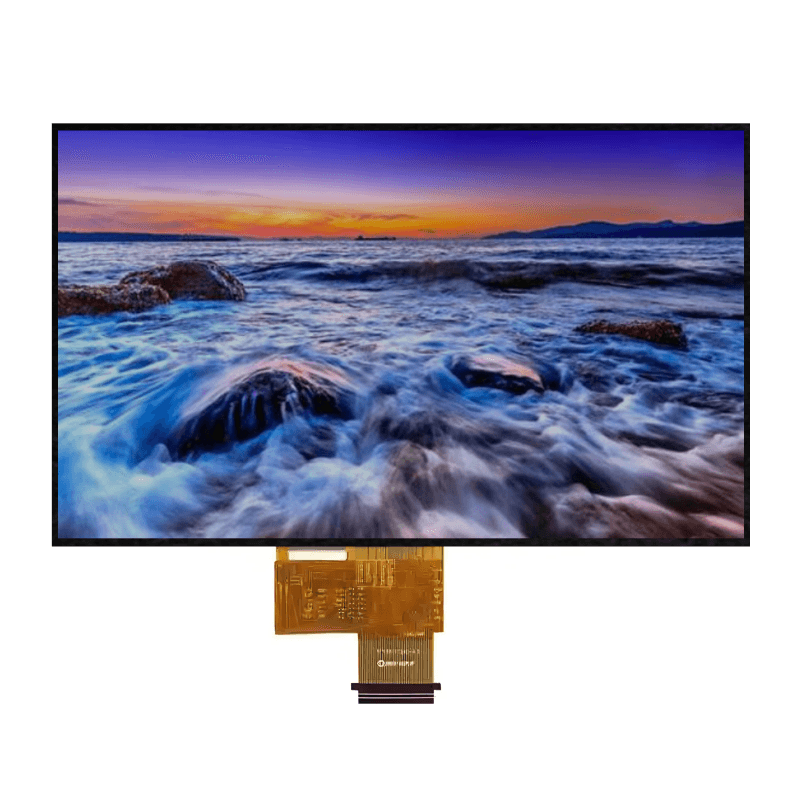
LCD (Passive Matrix) vs. TFT (Active Matrix) LCD: Advantages & Disadvantages
| Feature | Passive-Matrix LCD (e.g., STN, DSTN) | TFT-LCD (Active Matrix) |
|---|---|---|
| Image Quality | Lower contrast, duller colors, visible ghosting. | High contrast, vibrant colors, sharp images. |
| Response Time | Very slow (100-300ms), severe motion blur. | Fast (1-5ms typical for gaming), minimal blur. |
| Viewing Angles | Very narrow; image degrades quickly off-center. | Wide (often 170°/160° or more). |
| Power Consumption | Generally lower (no active transistor layer). | Generally higher, but efficient backlights help. |
| Complexity & Cost | Simpler structure, lower manufacturing cost. | Complex structure, historically higher cost (now very low at scale). |
Direct Comparison: TFT-LCD vs. Generic “LCD” Context
| Aspect | Traditional “LCD” (Passive Matrix Context) | TFT-LCD (Modern Standard) |
|---|---|---|
| Core Technology | Liquid Crystal + Passive Grid | Liquid Crystal + Active Matrix of Thin-Film Transistors |
| Pixel Control | Imprecise, via entire row/column. | Precise, via dedicated transistor per sub-pixel. |
| Primary Use Case | Simple, static displays (appliances, basic instrumentation). | Dynamic, high-performance displays (smartphones, TVs, monitors). |
| Market Perception | Often refers to older or low-performance displays. | The default “LCD” technology for most applications today. |
How to Choose Between Them?
The choice is straightforward in today’s market:
- For virtually any modern application requiring clear, dynamic imagery (computers, TVs, phones, digital signage, interactive kiosks), a TFT-LCD is the implicit and correct choice. The term “LCD” on a product spec sheet almost always means an active-matrix TFT-LCD.
- A non-TFT (passive-matrix) LCD would only be considered for extremely low-cost, low-power, or static display needs, such as in basic industrial controls, segment displays on appliances, or low-end wearable devices where image quality is irrelevant.
Applications Across Industries
TFT-LCD technology is ubiquitous:
- Consumer Electronics: Smartphones, tablets, laptops, televisions, digital cameras.
- Computing: Computer monitors, all-in-one PCs.
- Automotive: Digital dashboards, infotainment systems, rear-seat displays.
- Medical: Diagnostic displays (requying high brightness/contrast), patient monitoring.
- Industrial: Human-Machine Interfaces (HMIs), control panels, test equipment.
- Retail & Public: Digital signage, point-of-sale systems, information kiosks.
Future Trends
While TFT-LCD remains dominant in volume, the display industry is evolving:
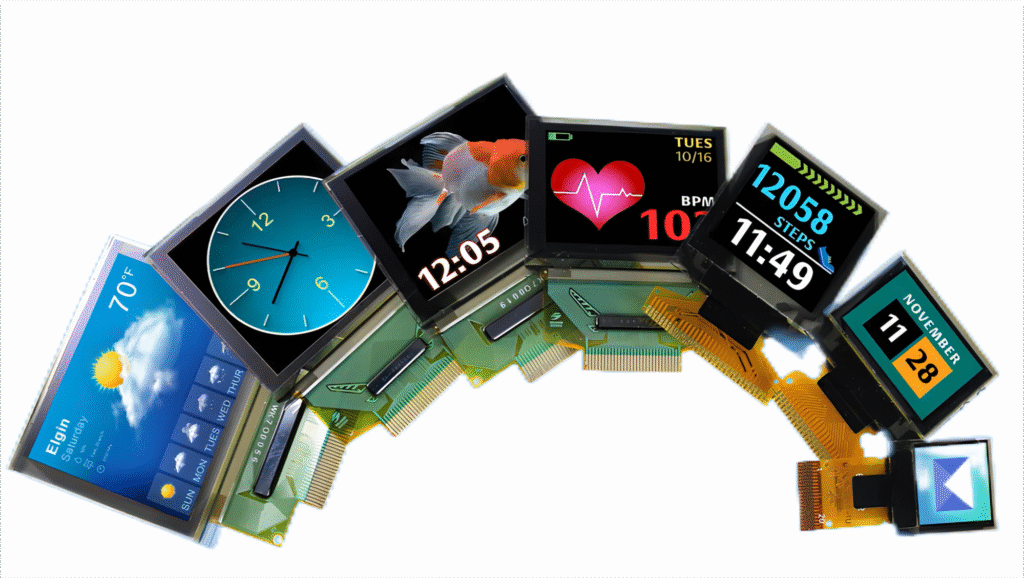
- Dominance of TFT Backplanes: The TFT manufacturing process is now the foundation for advanced technologies like OLED (Organic Light-Emitting Diode), where TFTs drive each self-emissive pixel.
- Shift to OLED & Micro-LED: For high-end applications, OLED (with better contrast and flexibility) and emerging Micro-LED (with higher brightness and longevity) are gaining share.
- LCD Enhancements: LCD technology continues to improve with Mini-LED backlighting (for better contrast) and Quantum Dot filters (for wider color gamut), keeping it highly competitive in the mid-to-high-end market.
- Form Factor Innovation: Developments in flexible and transparent displays, often using LTPS (Low-Temperature Poly-Silicon) or Oxide TFT backplanes.
Conclusion
To summarize, comparing “LCD” and “TFT” is less about two separate products and more about understanding the evolution of liquid crystal display technology. TFT is the advanced, active-matrix heart of the modern LCD. It solved the critical performance limitations of early passive-matrix LCDs, enabling the vibrant, fast, and sharp displays we now take for granted in every aspect of digital life. While new display technologies emerge, the principles and manufacturing scale of TFT-based displays ensure they will remain a pivotal part of the visual technology landscape for years to come.
FAQ (Frequently Asked Questions)
1. Is TFT better than LCD?
Yes, in the context of comparing modern TFT-LCDs to older passive-matrix LCDs. TFT provides vastly superior image quality, speed, and viewing angles. When you buy an “LCD” TV or monitor today, you are almost certainly buying a TFT-LCD.
2. Can an LCD be a TFT?
Yes. TFT describes the driving mechanism inside an LCD panel. Almost all LCDs manufactured for consumer electronics in the last two decades are TFT-LCDs.
3. Why are some displays still called just “LCD” and not “TFT-LCD”?
“LCD” is the broader category name and is often used in marketing for simplicity. “TFT-LCD” is a more technical term. In product specifications, you will often see the specific TFT type listed (e.g., IPS, VA, or TN panel).
4. Which has better image quality: IPS LCD or TFT LCD?
This question mixes categories. IPS (In-Plane Switching) is a type of TFT-LCD technology known for excellent color reproduction and wide viewing angles. When people say “TFT LCD,” they often refer to the older TN (Twisted Nematic) panel type. For image quality, an IPS LCD is generally superior to a TN TFT-LCD.
5. Does TFT or LCD consume more power?
A TFT-LCD’s transistor layer consumes some power, making it generally less efficient than a very simple passive-matrix LCD. However, modern TFT-LCDs use highly efficient LED backlights and power-saving features, making them suitable for battery-powered devices. For a comparable display size and brightness, a modern TFT-LCD is far more energy-efficient than an old CCFL-backlit LCD.